
When It Stops Being a DIY Job
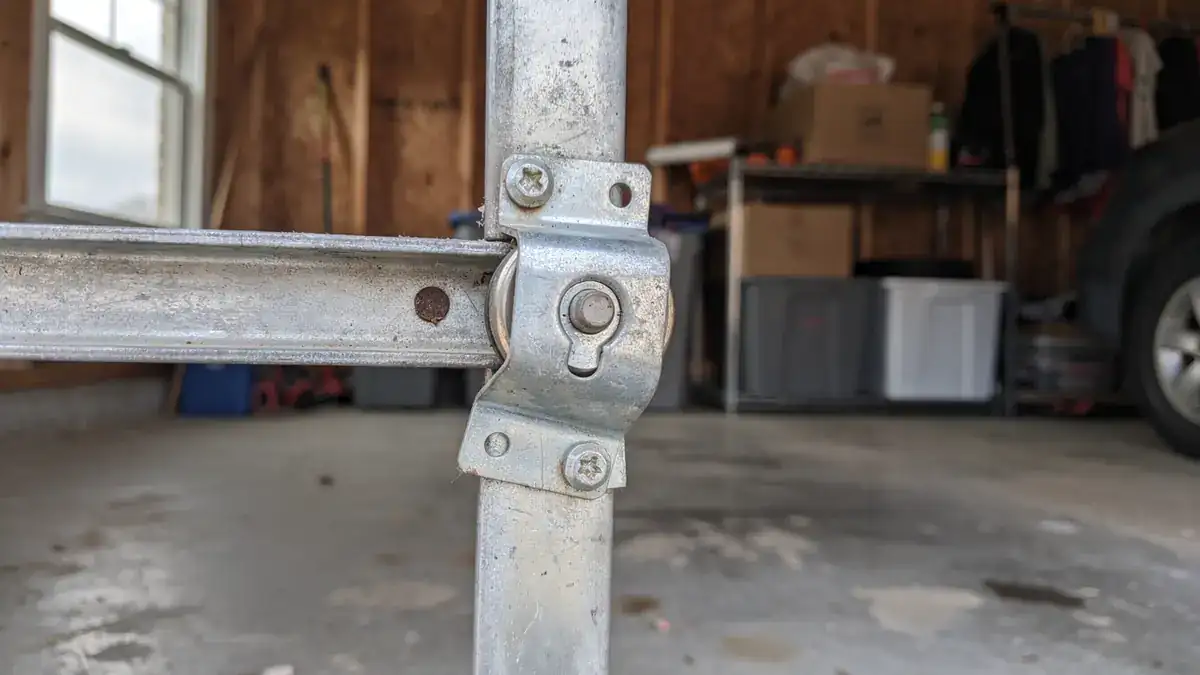
A door that's hopped the track isn't always a disaster, but it stops being a YouTube job the moment a cable is involved. If the door came off on one side only and you can see the roller sitting next to the rail instead of in it, and the door is still closed or mostly down, that's often a bent track section you can sometimes coax back with a rubber mallet and a level - carefully, with the opener unplugged.
It's a different story if the door is open, hanging crooked, or a spring let go at the same time the door jumped. Torsion springs on these doors carry real tension, and a bracket that's pulled loose from the jamb can let the whole panel swing free. With housing in this service area built mostly between 1973 and 2009 (median around 2002), a lot of the original track hardware is now old enough that the lag screws have worked loose in the wood jamb rather than the track itself being damaged. That's a call-it-in repair, not a mallet-and-level one. If you're not sure which situation you're looking at, that uncertainty is itself the answer.
One limitation worth saying plainly: we don't recommend trying to re-tension or replace a torsion spring yourself regardless of the door's age. That's not a track problem, it's a stored-energy problem.
Doing Nothing For Now
Leaving a door that's slightly off track alone for a week usually doesn't make the track worse
But it does make the opener work harder, and the opener is usually the thing that fails next. A door binding against a bent rail puts side-load on the opener's drive gear and on the rollers themselves, so a $40 track fix ignored for a season can turn into a roller replacement and an opener service call.
Given the median household income in this service area is $158,333, most owners here choose to fix the track properly the first time rather than nurse it along with shims or WD-40, and that's generally the cheaper path over a year or two
Doing nothing is a defensible short-term choice if the door still closes flush and locks - it's not defensible once the door is visibly racked or you hear grinding on the rollers.
The one case where waiting makes sense
If you're already planning a door replacement because the panel itself is dented or the insulation's failed, a misaligned track on a door you're retiring in a few months isn't worth a separate service call. Fix it once, with the new door.
How Local Conditions Play In
Addison sits in a moderate-heat climate band, and that matters more for tracks than most owners expect. Steel rail expands and contracts across summer heat cycles, and over years that movement works the mounting bolts loose at the bracket - not dramatically, a sixteenth of an inch at a time, until one day the roller has enough play to pop out on a hard stop or a strong gust against the door.
This shows up more in this area than in colder regions because the cycle happens every year without a long cold season to slow metal fatigue. It's not storm damage and it's not a manufacturing defect - it's just years of thermal movement on hardware that was torqued down once, in 2002 or whenever the house went up, and never checked again.
We don't see the kind of ice-dam or snow-load track failures you'd read about in colder-climate guides. Here, it's heat cycling and bracket fatigue, plain and simple. That's a useful thing to know before anyone tells you your track needs replacing when it's really the lag bolts that need re-driving into solid wood.
The Situation
Across the areas this shop covers - a few miles east, and the ring of towns further out - the housing stock is heavily 2000s construction. With 37,275 owner-occupied houses built mostly in that boom, a huge share of garages share the same door model, the same track gauge, and the same bracket wear pattern at roughly the same age.
That consistency is actually useful: when a track issue shows up on a house from this era, it's almost always one of three things - a loosened jamb bracket from heat cycling, a bent rail section from something hitting the door, or a roller that's worn enough to ride up out of the channel. It's rarely a structural issue with the garage opening itself, since these are younger houses, not century homes with settled foundations.
If your door's off track, the fastest way to know what you're dealing with is to look at where the roller sits relative to the rail and whether the bend is localized to one section or the whole track is pulling away from the frame. One tells you it's a quick fix; the other tells you it's time to call.











