
What Causes It Around Here
Addison's housing stock went up mostly between 1973 and 2009, with the median build year landing at 2002. That one number explains a lot of the calls we get. A door and opener installed when a house was built has a working life, and for a huge share of Addison houses, that clock is running out right now - not in five years, not ten years ago, but this year.
The climate here falls in a moderate-heat band, which shapes the failure differently than it would in a colder market. We don't see metal tracks locking up from ice. We see lubricant that's dried out from years of summer heat cycling, nylon rollers that have gone brittle and started chipping, and torsion springs that have lost tension slowly instead of snapping overnight. Heat doesn't break things fast. It wears them down quietly until a door that used to lift smooth starts groaning, sagging on one side, or stalling halfway up.
With 37,275 owner-occupied houses across the service area, most of them built in that same 1973-2009 window, this isn't a rare repair. It's the single most common reason an Addison homeowner calls.
What the Repair Takes
The first thing we do is figure out whether this is a spring job, an opener job, or both
Because a door built in the 2000s often has original hardware on all three fronts at once, and treating one symptom without checking the others just means a second call in a few months.
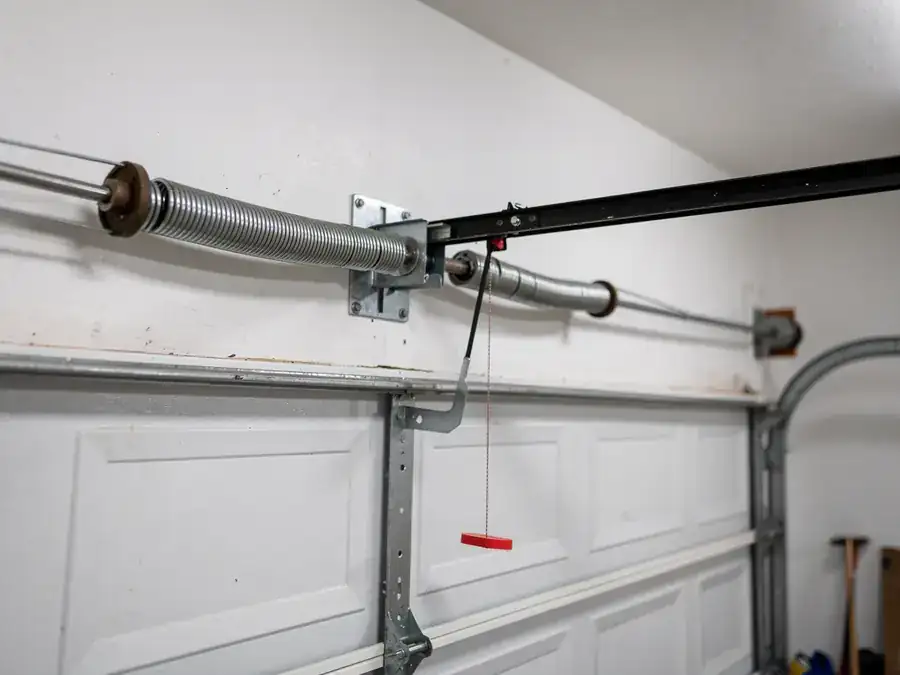
A torsion spring replacement on a standard double door is a controlled job
The spring is under heavy tension and gets wound down and swapped with the door secured, not left to drop. An opener that's original to a 2002-era build is usually a chain or belt-drive unit nearing or past the point where the gear kit, the circuit board, or the logic board is the actual point of failure, not just a dead remote battery.
Here's the honest limitation
If the opener is original to the house and the gear kit, capacitor, and board are all failing together, we're not going to spend your money patching three dying parts separately. At that point full opener replacement costs less over a year than three service calls, and we'll say so instead of running up a repair bill on hardware that's at the end of its life anyway.
Where This Job Goes Sideways
The job goes wrong when someone treats the symptom instead of the age of the house. A door that won't open gets a new remote, or a new battery, or a quick lube - and it works for a week, then fails again, because the actual problem was a spring that had already lost most of its tension from twenty-plus years of heat cycling.
It also goes sideways when a torsion spring is handled by someone without the right bars and a clamp, because a spring under full tension on a double door carries enough force to cause a real injury if it lets go while being wound or unwound. That's not a DIY repair, and it's not a job we rush.
The other place this falls apart: assuming every door built in the same era fails the same way. A 1970s-built house and a house finished closer to 2009 can both be in that median 2002 range on paper, but twenty years apart in actual hardware. We check the install date on the opener itself, not just the age of the house, before we quote anything.
What You Are Seeing
If your door is slow to start moving, if it shudders partway up, or if one side drops faster than the other when it closes, that's usually a spring that's lost tension unevenly - common on doors original to houses in that 1973-2009 range. If the opener motor runs but the door doesn't move, or the light blinks in a pattern instead of staying solid, that's almost always the circuit board or a worn gear, not the door itself.
A door that reverses right after touching the floor, or won't close all the way, points to the safety sensors or the close-limit setting drifting out of calibration - something that happens gradually as nylon housings age in heat, not something that breaks all at once.
Across the 45,576 households in this service area, median income runs high enough that most owners choose to replace an aging opener outright rather than keep patching it repair by repair, and that's usually the more sensible math once a unit is past the fifteen-year mark.

















