What Causes It Around Here
Most of the housing stock across this service area went up between 1973 and 2009, with the typical home dating to around 2002. That's a specific window, and it matters for openers. Builders in that era installed whatever chain-drive unit came standard with the door package - fine hardware for its time, but not built to run for decades without attention. Seventeen named areas in this market, from Highland Park out to Trophy Club, share that same 2000s-era construction wave, so the openers behind a lot of these doors are aging out in roughly the same stretch of years.
The climate here sits in a moderate heat band, which is kinder to circuit boards and belt material than a harsher desert or deep-humidity climate would be. That's the good news. The bad news is that years of attic-level heat sitting directly above an uninsulated garage still cooks logic boards and dries out drive belts faster than owners expect, even in a moderate band. Add in a garage that doubles as storage or a workshop, and dust plus heat cycling wears out limit switches and gear sets well before the door itself shows any wear.
What the Repair Takes
A straight opener swap starts with pulling the old unit down
Motor head, rail, and the wiring to the wall control and safety sensors. If the header above the door still has the original mounting bracket from the builder-grade install, that bracket often gets reused, assuming it's not bent or rusted through. New unit goes up, rail gets aligned to the door's travel, sensors get re-aimed at bumper height, and the whole thing gets run through a handful of open-close cycles to set travel limits and force settings correctly.
Where it gets longer is when the existing wiring doesn't match the new unit's control board
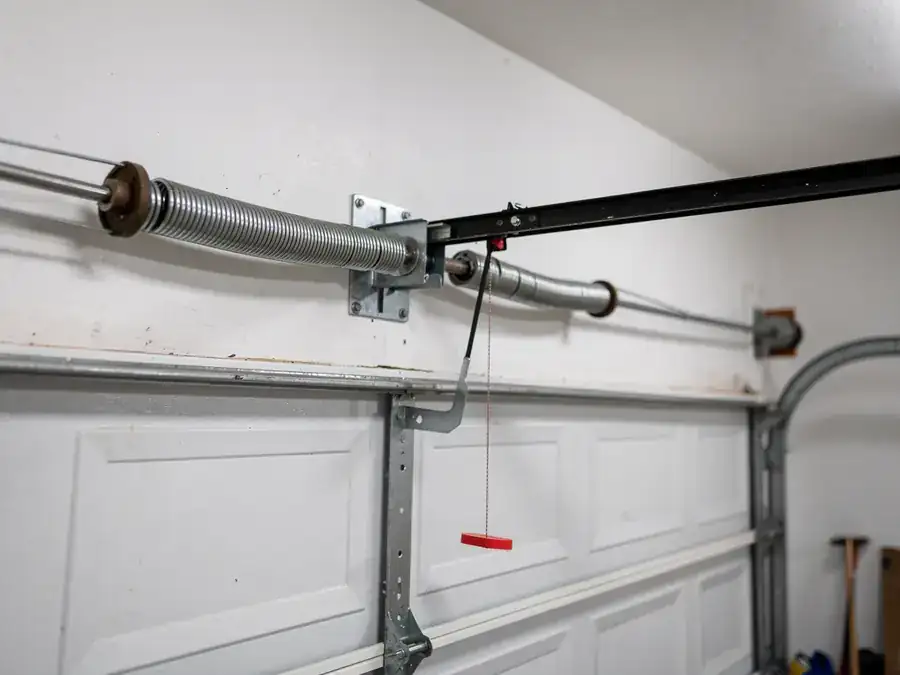
Or when the door itself needs a reinforcement strut added before an opener can safely pull on it - common on older doors from that 1973-2009 build window that were never upgraded to current bracing standards. We won't put a new opener on a door that can't handle the pull; that's a door repair first, opener second, and we'll say so rather than hang a new unit on bad hardware and call it done.
Where This Job Goes Sideways
The most common surprise on these jobs is the header itself. Doors built during this area's main construction wave often used a single light-duty bracket for a standard chain-drive opener. Swap in a heavier belt-drive unit, or one with a jackshaft motor, and that bracket isn't rated for the new load - it has to be replaced before the opener goes up, not after.
Wiring is the second spot. A lot of these houses were wired for a basic wall switch and nothing else - no dedicated circuit, no run for a smart control pad with Wi-Fi. Adding one means fishing new wire through a finished garage ceiling, which takes longer than the install itself some days.
The third spot is the door, not the opener. If the panels are original to a 2002-era build and have never had a safety cable retrofit or a broken spring replaced, we're not bolting a new motor onto a door that's one bad spring away from a drop. That gets flagged and fixed first. It's a smaller job than it sounds, but skipping it is how people end up back on the phone in six months.
What You Are Seeing
Usually it's one of a few things. The opener runs but the door crawls, taking twice as long to close as it used to - that's a worn drive belt or chain, common once a unit from the original builder install passes the fifteen-year mark. Sometimes it's the remote: works from the driveway but not from the street, or doesn't work at all, pointing to a dying circuit board rather than a dead battery.
Other times the door reverses before it touches the floor, which is the safety sensor doing its job against a misaligned beam, old wiring, or a motor that's lost the strength to finish the cycle under load. And every so often it's simpler than that - the opener just stopped responding to the wall button and the remote both, which usually means the logic board inside the motor head has finally given out after years of attic heat sitting on top of it.