
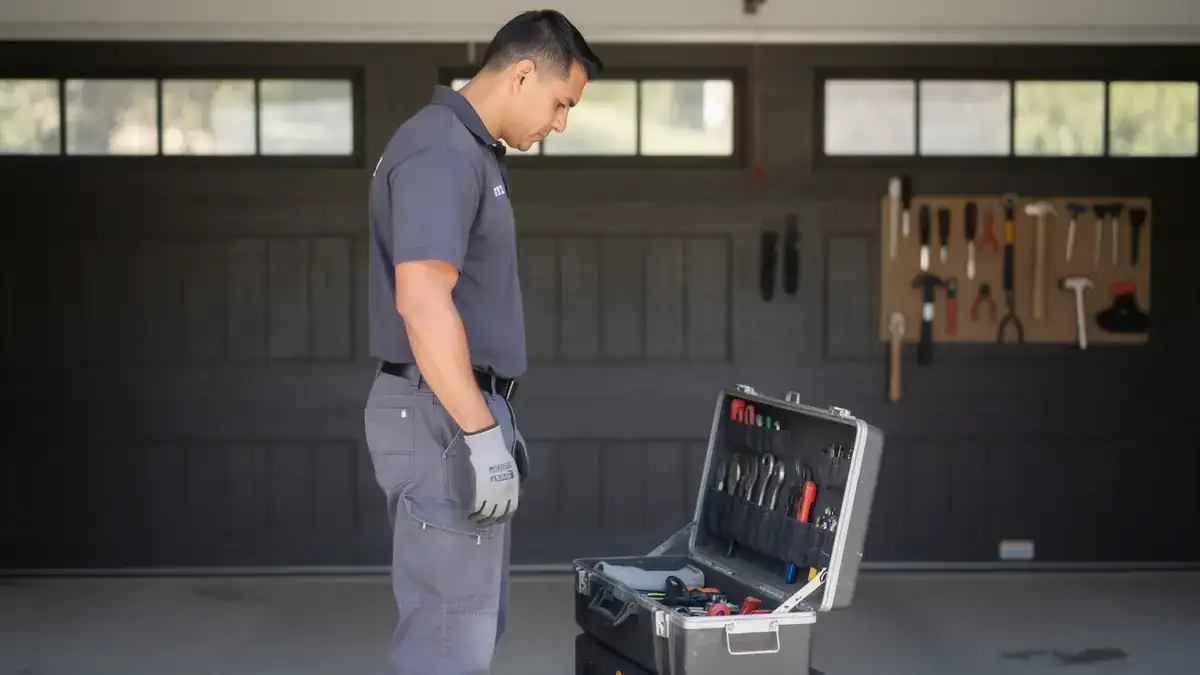
When It Stops Being a DIY Job
Most houses on this side of Addison went up somewhere between 1973 and 2009, with the bulk of that stock dating to around 2002. That matters because it puts a lot of doors in the range where the original torsion springs, openers, and rollers are at or past their rated cycle count. A worn roller or a loose hinge bolt is still a DIY fix - tighten it, lube it, move on. But a torsion spring on a door from that era is wound under enough tension to break a wrist or worse, and the drums, cables, and bearing plates on 2000s-built doors are matched sets. Swap one piece without the right bar and gauge and you're fighting the whole assembly, not just the broken part.
The line is simple: anything that touches the spring system, the cable under tension, or the opener's force settings is a call, not a Saturday project. Anything that's just friction - hinges, rollers, track alignment, weatherstripping - you can handle with a wrench and some patience. If you're not sure which side of that line you're on, that uncertainty is itself the answer. Call before you put a hand near a wound spring.
Doing Nothing For Now
Not every noise or sag needs a truck out the same week
If a door built in the 2000s is tracking straight, closing flush, and the opener reverses properly when it hits resistance, a little stiffness in cold weather or a slightly noisy roller isn't an emergency. Addison's climate band sits in the moderate-heat range, which means the big swings that stress steel doors and openers in harsher climates aren't the main threat here - it's cycle count and age doing the work, not temperature extremes.
Here's the honest limitation
We can't tell you over the phone whether your specific spring has another year left or two weeks. Spring wear doesn't announce itself with a clean signal - sometimes a door that sounds fine snaps the next morning, and sometimes a door that groans runs another year. If the door still balances when you disconnect the opener and lift it by hand, that's a reasonable sign things are holding. If it drops like dead weight or won't stay up, that's not a
How Local Conditions Play In
Addison's housing - built mostly from the 1970s through the 2000s, median year around 2002 - means a lot of the original hardware is nearing or past typical service life, not because of weather extremes but because of time and use. The climate here sits in the moderate-heat band, so we're not dealing with the kind of deep freeze that cracks seals or the hurricane-grade wind loads that some coastal codes require. What we do see is steady heat cycling that dries out nylon rollers and weatherstripping faster than a cooler climate would, and that shows up as noise before it shows up as failure.
With 37,275 owner-occupied houses across this service area and a median household income of $158,333, a lot of homeowners here are maintaining houses built in a narrow window of construction codes and materials, which means the failures cluster: same-era openers losing their logic boards, same-era springs reaching the end of their wind count around the same calendar years. That's not a coincidence - it's a cohort of doors aging together.











