
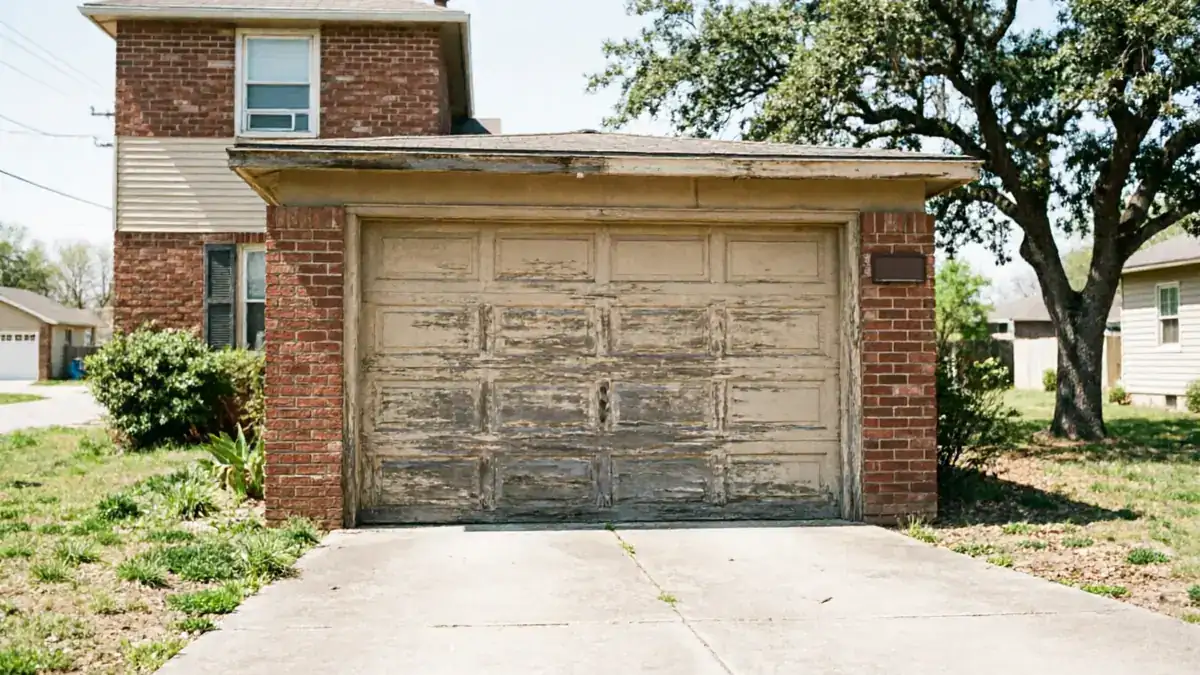
When It Stops Being a DIY Job
Most houses in this part of town went up somewhere between 1973 and 2009, with the bulk clustered around 2002. That matters because doors from that build era were sized and hung for openers and torsion springs that were standard then but aren't always the same gauge or mount pattern a big-box replacement spring comes in today. If you're working on a door from that window and the spring is original, swapping it yourself without knowing the wind cycle rating on the old one is how people end up with a door that slams instead of lowering. A bent track on a 2000s-era steel door is usually a bend you can true up with a wrench and a level. A door where the bottom panel has rusted through at the corners, which shows up more on the older end of that 1973-to-1990s range, isn't a DIY fix - the panel skin is gone and you're patching, not repairing. That's the line: fix what's bent or loose, call someone once metal has failed.
How Local Conditions Play In
This area sits in a moderate heat climate band, not the extreme swings you'd get further north or at higher elevation. That's actually good news for a door that's twenty-plus years old: you're not dealing with the freeze-thaw cycling that cracks seals and warps wood panels in colder climates. What you do get is sustained summer heat working on nylon rollers and plastic idler pulleys, which get brittle and crack years before the steel around them fails. On a door built in the early 2000s, that's usually the first part to go, long before the opener motor or the torsion spring. Check rollers and pulleys before you assume the whole unit needs replacing.
The Situation
Household income here runs high for the region, median around $158,333, and across the broader area there are 45,576 households. That combination tends to mean more owners replacing a door on their own schedule rather than waiting for total failure, and it means parts and newer opener models are easy to source locally rather than something you have to special-order and wait weeks on. Still, the honest limit: once a steel door from the 1970s or 80s has rust through the bottom panel and the track is pitted from years of exposure, we're not going to spend an hour trying to true up hardware that's past its service life. At that point a new door costs less over five years than patch repairs on an old one.











