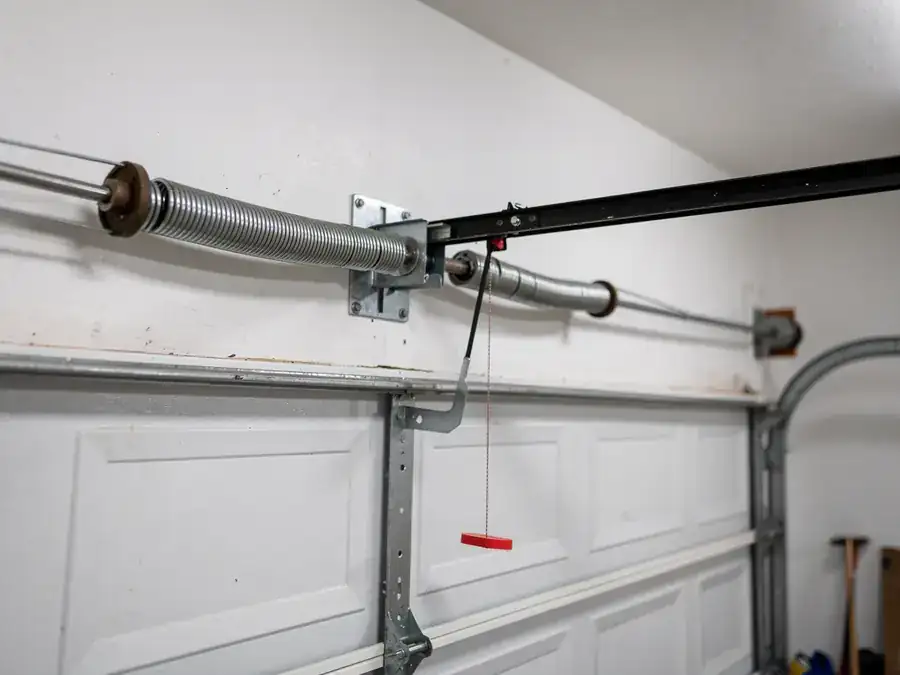
What Causes It Around Here
Most of the houses this company works on were built between 1973 and 2009, with the bulk of that stock going up around 2002. That matters for springs because torsion springs are rated by cycle count, not by calendar years, and a door that's been opening and closing two or three times a day for fifteen to twenty-five years is well into the range where the coil starts to fatigue even if nobody ever touched it.
Addison sits in a moderate heat climate band, and that heat does something specific to springs: steel expands and contracts through the day, and a spring that's already near the end of its rated cycle life loses tension faster under that kind of swing than one in a cooler, more stable climate. It's not dramatic - no single hot afternoon snaps a spring - but it shortens the runway.
Across the wider service area there are 37,275 owner-occupied houses out of 45,576 households, and a lot of those garages still have the original spring set that came with the house. If your home falls in that 1973-2009 build window and nobody's replaced the springs since you moved in, the math is simple: the spring is older than most of the cars that use the garage.
What the Repair Takes
A torsion spring repair is a measure-and-match job before it's anything else
We measure wire diameter, coil length, and inside diameter against the door's actual weight - a steel door isn't the same spring as an insulated or a carriage-style door of the same size, even on houses built in the same year. Get the match wrong and the door either slams down too hard or won't stay up on its own, which is its own kind of dangerous.
Most single-spring failures on a standard double door get fixed in one visit
Pull the broken coil, install the matched replacement, set the tension, run the door through a full cycle and check balance by hand. Two springs that are the same age usually fail close together, so if one side goes we'll generally recommend replacing both rather than leaving a ten-year-old spring next to a brand new one.
We also check the cable, drum, and bearing plate while we're in there
Since a spring failure under tension can nick a cable or bend a bottom bracket on its way down. That inspection is part of the job, not an upsell - skipping it just means a second service call later.
Where This Job Goes Sideways
The honest limitation here: we don't stock every spring size off the truck. Older torsion setups and a handful of non-standard door weights sometimes need a spring ordered to spec, which can add a day. We'll tell you up front if that's the case rather than installing something close enough and hoping.
The other place this goes wrong is when a homeowner tries to save the service call by loosening the winding cone themselves. A wound torsion spring holds enough stored force to break a wrist or worse, and we've seen enough of that around here to say plainly: this is not a DIY repair, full stop.
Last thing worth saying - sometimes a spring call turns into a door call. If the opener has been straining against a weak spring for months, the gears inside can wear out around the same time the spring finally lets go. We'll flag that during the visit instead of just swapping the spring and sending you on your way with a second failure six weeks out.
What You Are Seeing
The door feels heavier than it should when you lift it by hand with the opener disconnected - that's the clearest sign the spring has lost tension, even before it snaps outright. A loud bang from the garage, often mistaken for something falling, is usually the spring itself letting go.
Other signs: the door won't stay open halfway, it drops suddenly partway through closing, or the opener strains and reverses instead of finishing the cycle. Given the median household income of $158,333 across the service area, we see a fair number of homeowners who'd rather pay once for a correct, matched pair than patch one side and call again next year - that's a reasonable call given how close in age both springs usually are.
If you're not sure what you're looking at, don't force the door. A spring under partial tension that's about to fail is more dangerous to handle than one that's already broken clean.