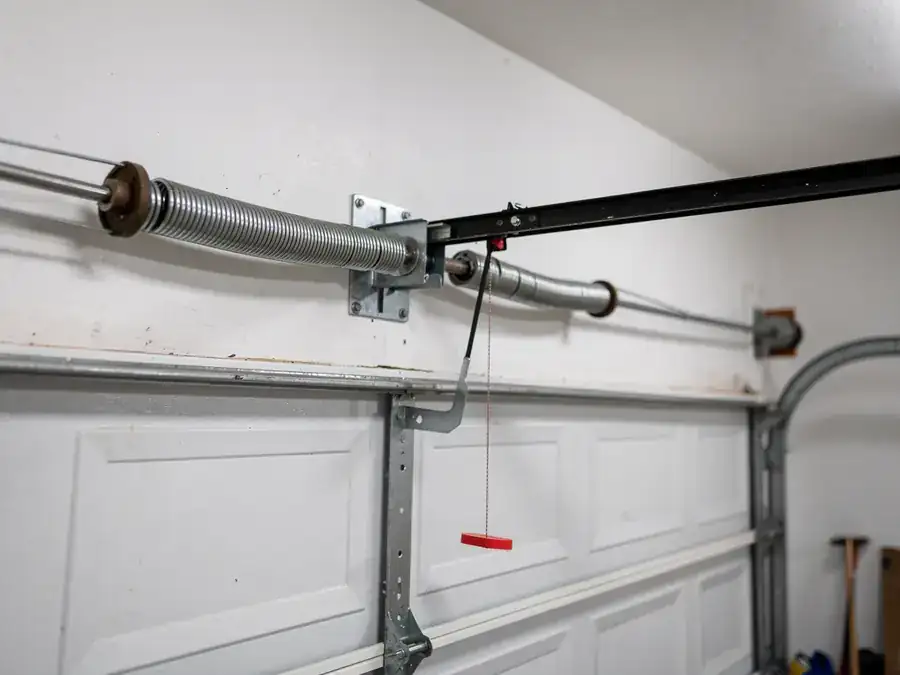
What Causes It Around Here
Most of the housing stock in this service area went up between 1973 and 2009, with a median build year around 2002. That matters for cables because the galvanized aircraft cable on a torsion or extension system has a working life measured in years of cycles, not decades. A door built in 2002 that's been opened and closed a few times a day has put a lot of wear on those strands, and the original cable is often still on the drum.
The climate here runs moderate on heat, so you're not getting the brutal freeze-thaw cycling that snaps cables cold in northern winters. Instead the wear pattern is slower and more mechanical: drums that lose their set screws over time, a cable that starts walking off the drum groove instead of staying wound tight, or strands that fray where the cable rubs against the bottom bracket. Heat does play a role indirectly - warm garages mean grease and lubricant on the drum and cable dry out faster than people expect, and a dry cable wears against metal instead of riding smooth.
Across the 17 named areas in this service territory, the housing is mostly 2000s-era construction, which means a lot of doors are hitting that 15-to-20-year mark on original hardware at roughly the same time. It's not one bad batch of cable - it's a lot of houses built in the same decade aging out together.
What the Repair Takes
A cable repair on a torsion system means winding down the springs first
You don't touch the cable or drums with tension still on the shaft. We pull the old cable, check the drum groove for wear or a cracked flange, and check the bottom bracket where the cable terminates, since that's a common fray point. If the drum itself is scored or the groove is chewed up, replacing just the cable and leaving a bad drum is a callback waiting to happen, so we replace both together.
On extension-spring systems the cable work is different
It runs through a pulley at the top of the track, and that pulley bearing is usually the thing that's actually failed, not the cable. We check that before quoting a cable-only fix.
We always do both cables on a double door, even if only one has snapped
If one cable failed from age and wear, the other one went up the same day and has the same mileage on it. Replacing one and leaving the other is asking for a second visit within a season. The honest limitation here: if the drums, bottom brackets, or track are also worn past spec, a cable-only repair won't hold, and we'll tell you that on site rather than sell you a fix that doesn't last.
Where This Job Goes Sideways
The door most homeowners describe as a cable problem is sometimes something else wearing in parallel. A door that's crooked, hanging lower on one side, or slamming down fast is showing classic snapped-cable or off-track-cable symptoms, but if the opener kept running after the cable let go, you can also have a stripped gear or a bent rail from the door dropping unevenly. We check the whole lift system, not just the cable, before we call it done.
The other place this goes wrong is when someone tries to free a jammed door by hand without releasing spring tension first. A cable under load that's about to fail is dangerous to work near, and a torsion spring with stored energy can do real damage if the cable lets go while someone's hands are on the door. If your cable has already snapped and the door is stuck halfway, leave it. Don't force the opener, don't cut the cable loose, and don't try to rewind a drum yourself.
With household incomes in this area running well above the regional median, we also see people reach for full door replacement when a cable repair would have done the job - and the reverse, patching a door whose track and drums are too far gone for a cable fix to stick. We'll tell you honestly which situation you're in.
What You Are Seeing
A snapped cable usually shows up as a loud bang, the door dropping unevenly, or one side hanging lower than the other while the cable dangles loose off the drum. Sometimes the door won't move at all because the opener senses the imbalance and stops. Other times the symptoms are quieter: a door that drifts to one side as it travels, a cable that looks frayed or has visible broken strands near the bottom bracket, or a drum that's slipped along the torsion shaft so the cable winds unevenly.
If you catch it early - fraying strands, a cable that looks thinner or shows rust spots, a drum making a grinding noise - that's the point to call before it snaps on its own schedule, usually with the door open and something underneath it. Across the 37,275 owner-occupied houses in this service area, most of them sitting on that same 1970s-to-2000s hardware, cable wear is one of the most common calls we get, right alongside worn springs on the same-age doors.