What Causes It Around Here
Most houses in Addison went up between 1973 and 2009, with the typical build year sitting around 2002. That means a lot of doors and openers on the street are the originals, or close to it, and they're all aging out at roughly the same time. A door and opener from the early 2000s is built to last fifteen to twenty good years before the springs, rollers, and gearing start giving out together rather than one at a time.
Addison sits in a moderate-heat climate band, not a severe one, but moderate heat still does steady damage over two decades. Vinyl weatherstripping dries and splits, nylon rollers go brittle, and the lubricant in an old torsion spring cooks down faster than people expect. None of that is dramatic failure - it's slow wear that shows up as a door that's noisier, slower, and harder to trust every year.
Across the service area, the 2000s stock dominates seventeen named areas, which means installers aren't guessing at what's behind the wall. The track width, header clearance, and bracket spacing from that building wave repeat house after house. That consistency is exactly why a straight swap - pulling the old door and opener and setting a new one in the same opening - is usually the right call instead of patching hardware that's past its working life.
What the Repair Takes
An install starts with measuring the opening and checking what's actually holding the current door up
Torsion spring size, track type, header depth, and whether the opener bracket is original or already replaced once. Houses from the 1973-2009 wave mostly use the same torsion hardware, so sizing the new door to the existing track is usually straightforward.
The old door comes out in sections, the track and spring assembly gets pulled if it's not being reused
And the new door goes in panel by panel with new rollers and hinges rather than reusing anything from the old setup - reused hardware is the first thing to fail again. The opener gets mounted or reused depending on its age and condition; if it's original to a 2002-era house, it's usually due for replacement at the same time rather than bolted onto a new door.
Balance and travel get set and tested last
The door needs to lift and seat evenly with the spring doing the work, not the opener motor straining against a door that's out of balance. A door that closes crooked or an opener that labors on the way up almost always traces back to this step being rushed. That's the part that separates a clean install from one that needs a callback in six months.
Where This Job Goes Sideways
The most common surprise on a house from this era is a header or wall that's shallower than a new door's hardware expects. Builders in the 1973-2009 window used a range of track and spring configurations even within the same neighborhood, so a door that looks like a drop-in replacement sometimes needs a different spring size or a low-headroom track kit once the old one comes down.
The other place this job slows down is the opener. If the house still has its original unit, the mounting bracket and rail length were sized for the original door's weight, not necessarily for a new insulated steel door, which weighs more. Swapping brackets mid-job adds time that isn't always obvious from a phone estimate.
Here's the honest limit: we can't give a firm price before someone looks at the opening in person. A quote based on photos or a phone description is a range, not a number, because the spring size and bracket condition only show up once the old door is off the track. Anyone who quotes a firm price sight-unseen on a house this age is guessing, and the guess usually favors them, not you.
What You Are Seeing
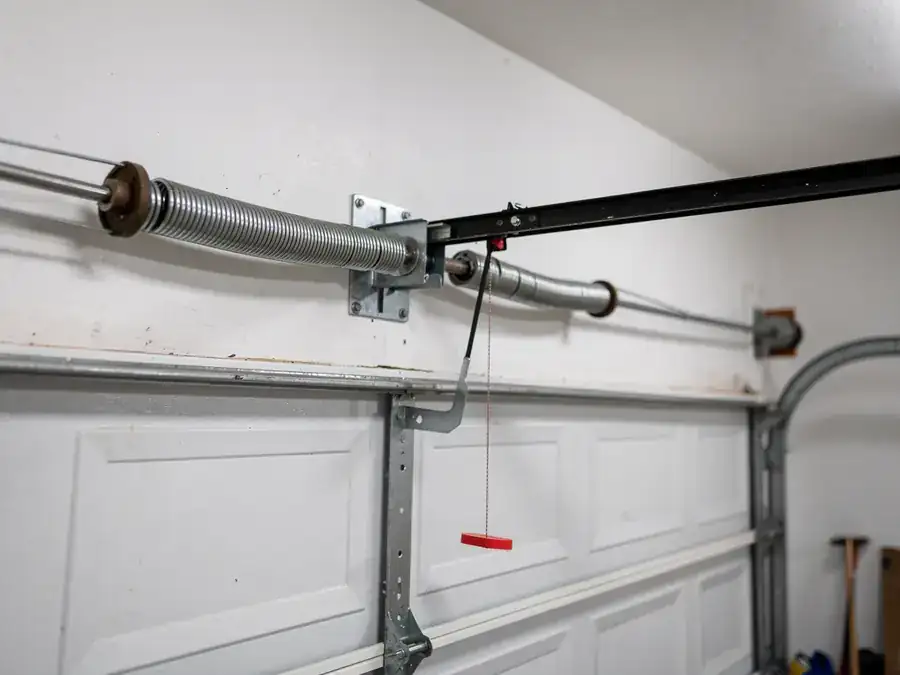
The signs that it's time for a new door rather than another repair usually show up together, not alone. A door that sags visibly at the bottom corners, an opener that strains or stalls partway up, cables with visible fraying, or a torsion spring with a gap in one of its coils are all signs the whole assembly is past the point where a single part swap fixes it.
In a moderate-heat climate like Addison's, you'll often notice it first as noise - a door that used to run quiet starts grinding or chattering as the rollers dry out, well before anything actually breaks. If your house falls in that 1973-2009 build window and the door has never been replaced, that noise is usually the hardware telling you it's near the end, not a one-off fix waiting to happen.
Given the median household income in this part of the service area, most owners choosing a replacement door go with an insulated steel panel rather than the single-layer door their house likely came with - it holds up better against the same heat cycling that wore out the original. That's a reasonable upgrade to plan for rather than something to decide on the spot.